Nobody is Coming to Help After a Disaster — Nobody but Us
North Coast Journal | by Laurie Richmond and Erin Kelly March 26, 2026
“What each of us can do to make our community more resilient”
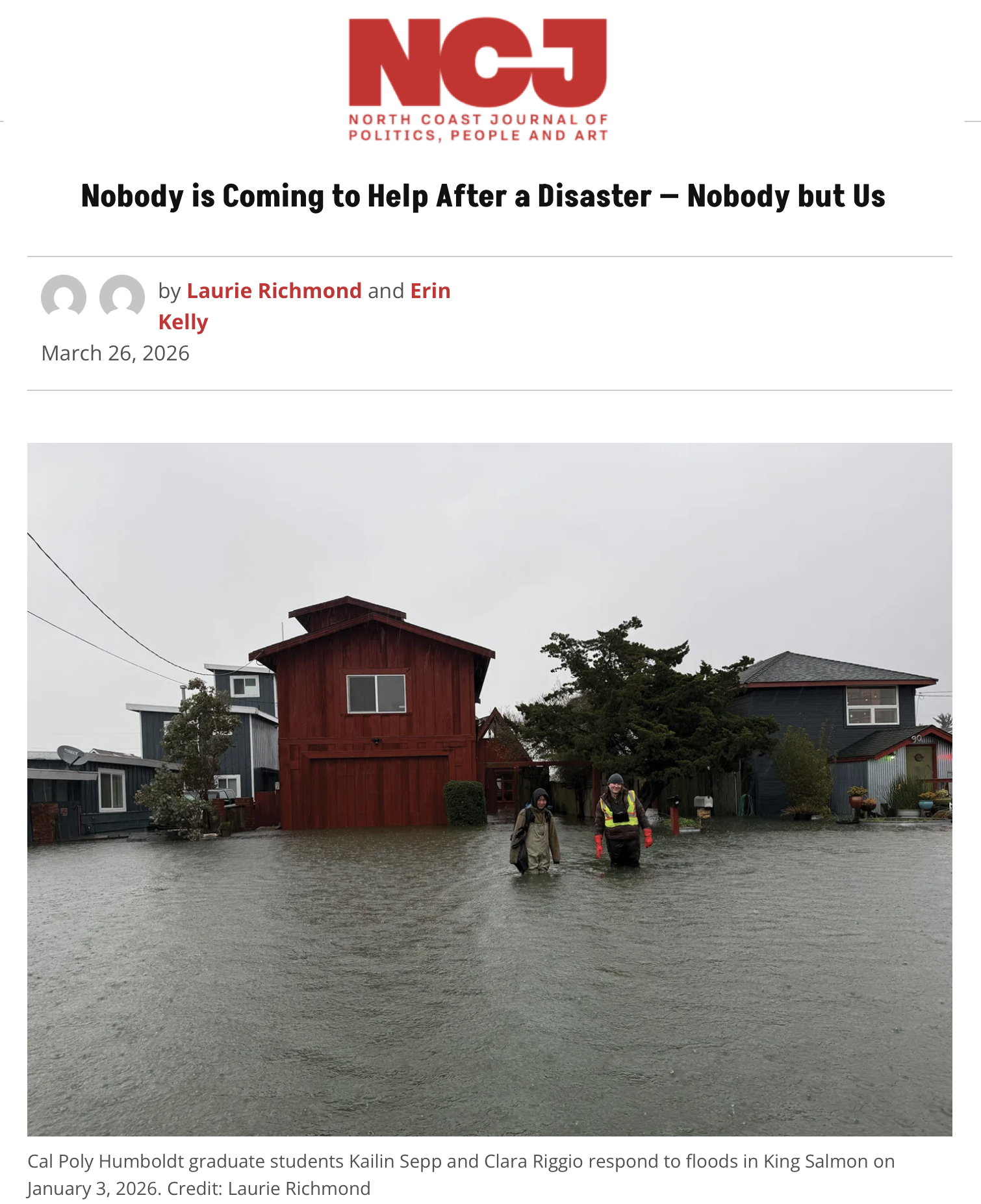
It’s been a difficult start to the year in our corner of far Northern California, with record tidal flooding that inundated more than 40 homes in King Salmon Jan. 4-6, the same weekend as the fire in downtown Arcata. Just over a year prior on Dec. 5, 2024, our community experienced a magnitude 7.0 earthquake and tsunami warning — a stark reminder of the seismic risks our region faces. To the east, huge wildfires return almost annually, with the August Complex and Slater fires in 2020 burning through communities in Trinity and Siskiyou counties, killing three people and destroying hundreds of homes.
While our geographic location has always placed us at risk of disasters, climate change will only make things worse, bringing sea-level rise and increased coastal flooding, wildfires of larger size and severity, and greater potential for extreme weather events.
We are two faculty members from Cal Poly Humboldt who research community aspects of natural resource issues. Because of recent events, we have been documenting how disaster response and recovery does and does not work in our region. We hope to share some of what we have learned here.
The general public may assume that after a disaster the government will provide relief and support. We might imagine that after a disaster teams of Federal Emergency Management Agency (FEMA) workers flock to a site to assist and Congress grants millions or billions of dollars to support recovery. The truth is that federal or state assistance following a disaster is rare in our region. Federal and state emergency declarations require that the disaster meet certain thresholds, often related to the financial costs of damage. Due to our rural location and comparatively lower property values, these thresholds, particularly at the federal level, are difficult to meet. If there is no emergency declaration, then the individual and public assistance programs offered by FEMA are not available to survivors.
For example, the 2022 Rio Dell earthquake that severely damaged 25 percent of the city’s housing stock and caused $35 million in damage to the county did not meet the threshold for a federal declaration. Because housing and communities are so remote and dispersed in many of the wildfire-impacted communities in our region, very few fires meet FEMA’s threshold for assistance. The 2017 Helena Fire in Trinity County burned 72 homes in the town of Junction City, but was not declared a disaster. Federal thresholds would have required more than 400 homes to burn.
Even if disasters do meet federal or state disaster thresholds, such as with the 2020 wildfires, the resources and payments are not nearly enough to make people whole, and payments can be delayed by complex bureaucratic processes. Many people who most need assistance lack internet connectivity and support services to access funding and to navigate the paperwork required to receive assistance. It is worth noting that federal support for disasters is likely only to decrease in the coming years. The current administration has already made cuts to FEMA staff and programs, and has floated plans to decrease federal commitment to disasters and even eliminate FEMA entirely.
Individual counties can issue a disaster proclamation following an event. While this can draw attention to the issue, it does not come with any funding. Each county in the region has an Office of Emergency Services (OES), which is responsible for coordinating disaster response locally, including issuing emergency alerts. Their focus is on immediate response to protect human lives (e.g. search and rescue, sheltering, evacuations, critical medical care, food and drinking water). These OES offices are generally under-resourced, which can limit their role in the aftermath of a disaster. None of our region’s counties has any permanent staff to support longer-term post-disaster recovery and rebuilding processes.
Support from the private sector can be significant, whether through insurance or GoFundMe solicitations. But we are seeing the strains of these systems under the increasing frequency of disasters, as many insurance companies have stopped insuring in California altogether because of fire risk. While GoFundMe accounts can provide relief to certain individuals, they tend to disproportionately help people who already have support networks. So crowdsourcing accounts are not a scalable model that can help everyone.
The truth is that most of the disaster response and recovery processes in our region have been, and will need to continue to be, led by us: community members and community organizations. Many counties have worked to develop Community or Volunteer Organizations Active in Disaster (COADs or VOADs) which bring together community organizations to mitigate and respond to disasters. COADs and VOADs are part of a nationwide network and their members have developed specialized expertise in disaster response and long-term recovery. The Humboldt COAD is particularly strong and experienced. It brings together community organizations throughout the county to mitigate and respond to disasters. They help lead long-term recovery including developing case management processes and supporting the physical and emotional/spiritual needs of survivors.
The Humboldt COAD network also facilitates connecting survivors with external groups that can be mobilized after disasters, from governmental agencies (e.g. FEMA, the Small Business Administration and Cal OES) to bigger external organizations (e.g. Habitat for Humanity, Team Rubicon and United Way). In places outside of Humboldt, other organizations have stepped up to help lead recovery, such as the Karuk Tribe and the Happy Camp Community Center, which formed the Slater Long Term Recovery Group after the Slater Fire.
Local organizations, including COADs and VOADs, are well-positioned to provide disaster assistance. They understand the context, have preexisting relationships of trust within the community and have the appropriate expertise. Given the dearth of federal, state and county government support, they often play the leading role in disaster recovery. However, they are chronically underfunded and underrecognized, given their critical role. Additionally, these networks are not as strong or available in rural and remote places in our region including parts of Del Norte, Trinity and Siskiyou counties.
So it is important for every North Coast resident to prepare to take on the responsibility of caring for themselves and their fellow community members, should something happen. Below is a list of actions all of us can take to make our communities more resilient and prepared for future disasters:
Take steps to prepare your family and your property for potential disasters. Have a conversation with your family and loved ones to create a disaster plan, put together a go-bag, and have a two-week supply of food and water in your house. Review and follow the earthquake and tsunami guidance in the Living on Shaky Ground magazine. Take steps to mitigate your property from future hazard risks, such as flood or fire-proofing steps like creating defensible space around your home. Sign-up for Humboldt, Trinity, Siskiyou and/or Del Norte OES Emergency Alerts, and develop a habit of closely following weather, fire and tide information so you can be aware of when potential hazards may come your way. Stay on top of your insurance coverage and get as much as you can. Insurance in our state is a total mess and it can be tempting to go without, but it is still the best financial protection from future disasters. When making decisions about insurance coverage, do not assume that federal assistance will arrive to help pay for damage after a disaster.
Get to know your neighbors. In a disaster, your neighbors might be your first responders (or you theirs). Strong relationships and a foundation of trust with your neighbors will improve your ability to navigate disasters. Sometimes neighbors get to know each other aftera disaster, as they grapple with immediate, basic needs in the aftermath of an event. But forming these connections before a disaster can help people identify who could need extra help or who has special skills or resources. Talking to neighbors, mapping your neighborhood and hosting neighborhood potlucks can all create a network of support. Even just having your neighbors’ phone numbers can be helpful. Research shows that strong social ties are a huge asset in disaster response and recovery.
Become involved in a civic or community group that can play a role in disaster recovery.Faith-based, mutual aid and other community organizations can play a big role in helping our community after a disaster. They bring together people who can be galvanized in the event of a disaster. Venues such as granges, Elks lodges and community centers or halls can become important gathering and staging areas following a disaster. Unfortunately, many civic organizations are seeing a generational decline and are in need of fresh participation and leadership. For example, the Humboldt Grange became an important site and resource following the King Salmon floods, but only has 25 members remaining.
Donate and/or volunteer to support community organizations involved in disaster response and recovery. Nonprofit organizations primarily run disaster response and recovery efforts, and we need to make sure that these organizations remain healthy to serve us in times of need. Research which groups in your area are active in disasters, perhaps through their participation in county COAD/VOADs. For example, Humboldt COAD has a list of partner organizations. Humboldt Area Foundation’s (HAF) disaster response and resilience fund provides gap funding to support disaster recovery throughout the broader North Coast region. HAF is able to quickly get funds to the organizations doing work on the ground. If you don’t have funds to give, many of these groups have opportunities for volunteers to assist with disaster recovery activities. The Humboldt Community Emergency Response Team Coalition (CERT) provides information and training for individuals who wish to learn more or be more involved in emergency response. Other counties host CERT trainings fairly regularly.
It can be empowering to take ownership and responsibility for disaster recovery. For such a rural area, we have a robust foundation of community organizations and an extraordinarily strong constellation of local tribal governments that hold generational cultural values of caring for community and have been leaders in disaster preparedness and response for our region. Blue Lake Rancheria built a microgrid to bring energy resilience to our community during disasters. The Yurok Tribe has an impressive OES that operates across three counties. Additionally, due to their sovereign status, tribes are able to directly request disaster declarations and support from federal entities, something the Karuk Tribe did during the Slater Fire.
Many of the steps above will benefit our community beyond disaster preparedness. Getting involved in local organizations and building relationships with your neighbors can be fun, as well as helping address our nation’s loneliness epidemic. So don’t delay! We challenge everyone to volunteer for that organization, to join that board, to donate those funds, or to plan that community gathering. We can all be inspired by the words Christine E. Nieves Rodriguez wrote about her community’s response and recovery process following Hurricane Maria in Puerto Rico:
“Community is our best chance . . . It turns out that communities are the most important force that allows humans to weather great storms, literally and metaphorically. The climate crisis will intensify, but our communities will continue to rise — because they are already standing.”
Laurie Richmond is faculty at Cal Poly Humboldt in the Department of Environmental Science and Management, and an extension specialist for California Sea Grant. You can learn more about her work at: laurierichmond.net.
Erin Kelly is department chair and professor at Cal Poly Humboldt in the Department of Forestry, Fire and Rangeland Management. Learn more at humboldt.edu/forestry-fire-rangeland-management/faculty-staff.
Graduate students Catriona Barr, Clara Riggi, and Kailin Sepp were instrumental in the research and engagement that helped inform this piece.
This article appears in On the Matter of Censure
